Dynamic Pricing for Tours and Attractions: A Practical Guide

The case for pricing the same experience differently on different days: why a flat price loses money, which levers matter, and how to measure the lift.
Ask most operators about dynamic pricing and they picture an algorithm quietly raising prices behind the scenes, the way airlines and rideshare apps do. So they skip it. A whale watching captain or a zip line owner doesn't want a black box deciding what a family pays.
Here is the part that gets missed. Dynamic pricing for tours and attractions isn't an algorithm. It's a decision you make on purpose: the same experience is worth different amounts at different moments, so it shouldn't always cost the same. The black box is the flat price, because nobody remembers why it is what it is.
What is dynamic pricing for tours and attractions?
Dynamic pricing means the price depends on the booking, not just the product. A Saturday in July costs more than a Tuesday in February. A party of twelve pays a different per-person rate than a couple. A guest who books three months ahead pays something different from one who walks up an hour before departure.
For an operator, the useful version is rule-based. You decide the conditions, you decide the prices, and the rules run automatically. Nothing changes on its own, and you can always explain why a guest paid what they paid.
Why does a flat price leave money on the table?
Two ideas explain almost all of it.
The first is that your inventory expires. A seat on the 2 p.m. departure is worth something until the boat leaves, then it is worth nothing. You can't store it and sell it tomorrow. An empty seat is a permanent loss, which is why filling a quiet departure at a lower price can beat leaving it empty.
The second is that guests don't value the same seat the same way. The family that has planned a vacation around a holiday weekend will pay more than a local who could go any Tuesday. A single price has to be wrong for one of them.
Picture a boat tour running the same $60 ticket every day. On a Tuesday in February, that price loses bookings you could have won. On the Saturday of a holiday weekend, the boat fills at $60 and you never learn what the last twenty seats were worth. Either way, the flat price isn't a decision. It's a guess you stopped revisiting.
Which levers should operators use?
Think of each lever as a signal about how much a booking is worth to you or to the guest. You don't need all of them. Most operators get most of the value from the first two.
Time of year and day of the week come first. Demand follows seasons, weekends, and holidays, and you already know your calendar better than any model would. This is the lowest-risk lever because guests expect it. Nobody is surprised that a holiday weekend costs more.
Lead time is next. Guests who book far ahead are planning and are often price-sensitive, so an early-bird price rewards them and locks in revenue sooner. Guests booking at the last minute are usually deciding on impulse, which supports either a premium when you are nearly full or a discount to fill a departure that is going out half empty.
Party size changes your costs and your goals. A large group fills a boat in one transaction and takes fewer sales conversations, so many operators price per person lower for bigger parties. Others price groups higher because a private charter blocks the whole departure. Decide which problem you are solving first.
Remaining capacity is the scarcity lever. A nearly full departure signals demand, and a mostly empty one signals the opposite. Used carefully, it lets price follow how full a departure actually is.
Channel is the lever operators overlook, and it is real money. A guest booking on your website pays retail. A reseller sending you a block of bookings usually needs a wholesale rate that reflects the economics of that relationship. Pricing the same activity differently by channel on purpose beats discovering the gap later.
How do you decide how much to change a price?
Start from your own history, not a competitor's price list. Look at the days you sell out with no effort and the days you run half empty. The sell-out days are where a modest increase is most likely to hold. The empty days are where a modest discount is most likely to add bookings you would not have had.
Keep the steps small. A change of a few dollars is a test. A change of thirty percent is a bet. You can always go further once you've seen what happens.
Then decide your floor before you start. Know the lowest price at which a departure still makes sense after fuel, guides, and fees, so a promotional price never turns a full boat into a loss.
How do you measure whether dynamic pricing is working?
Measure lift, which means the difference between what happened and what would have happened at the old price. You can't see the second number directly, so you approximate it.
Change one rule at a time and compare the same kind of day before and after. If you raise a weekend price, compare the new weekends to the weekends before, not to a weekday. Watch two numbers together: revenue per available seat, and how full your departures are. A higher price that empties the boat has not lifted anything.
Give each change enough time to show up in your bookings. Guests book weeks ahead, so a rule can take a while to show up in your results. The lesson Analyzing Dynamic Pricing Results shows how to find your busiest and slowest periods in your own reports, and the Heatmap lesson shows sell-through across your calendar.
When does dynamic pricing backfire?
Three situations cause most of the trouble, and none of them are technical.
The first is surprise. Guests don't mind a higher weekend price if it is visible and consistent. They mind a price that changes between the moment they decide and the moment they pay. Keep your rules simple enough to explain in one sentence.
The second is complexity your own team cannot explain. If your front desk can't tell a guest why Saturday costs more, you have too many overlapping rules. Fewer, clearer rules beat a clever stack.
The third is mistaking a price change for a fix. Raising a price does not repair a weak departure time, and discounting does not repair a poor review score. Pricing moves demand around. It doesn't create it.
Is dynamic pricing legal, and what about surveillance pricing?
Regulators have started looking at a different practice that shares a name. Bloomberg Law reported in April 2026 that state lawmakers have introduced more than 70 bills to crack down on surveillance pricing across industries, including travel.
Surveillance pricing generally means charging an individual a different price based on personal data about them. The levers in this guide are different. They price the booking, by date, party size, lead time, remaining capacity, and channel, and they don't look up who the guest is. Laws vary by state and are changing, so check with your own counsel before relying on that distinction.
How does TripWorks support dynamic pricing?
In TripWorks you write each of these as a rate sheet: a pricing rule with its own conditions and prices, layered on top of your base rate. Every price is one you entered, and a new rule stays a draft until you set it live. Nothing reprices on its own.
Before a rule goes live, you can check a price for any date, channel, and party size and see which rule would apply. That is how you confirm a weekend increase lands where you intended.
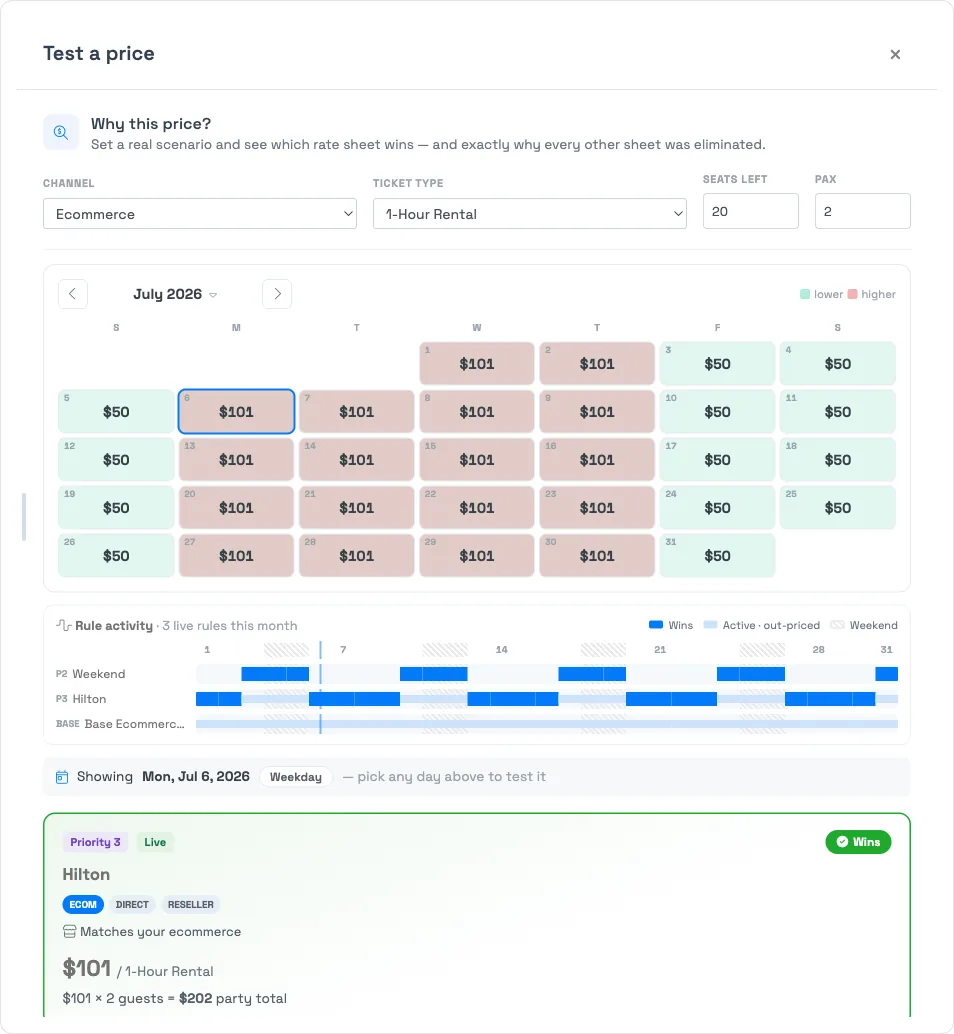
For the step-by-step setup, the help center covers rate sheets, seasonal pricing, and checking a price before it goes live, and the University lesson Using Dynamic Pricing Effectively walks through the whole flow on video.
Where should an operator start?
With one rule on one activity. For a small operator, a weekend price is usually the right first move. For a larger one with many resellers, a wholesale rate by channel is usually worth doing first, because it replaces manual adjustments you are likely making today.
Pick the day you are most confident is undervalued, move it a little, and watch what happens for a few weeks. If you are charging one flat rate today, that is the whole next step.
The mental model worth keeping: your price isn't a number you set once. It's a set of promises about when your product is worth more, and the work is deciding which ones to make.
Stop guessing. Start growing with TripWorks.
Schedule a consultation with a senior growth expert.